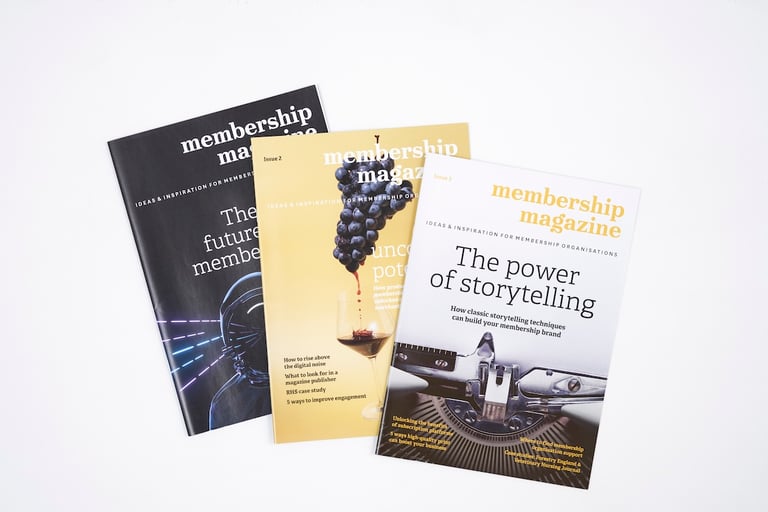
A common assumption is that replacing a printed membership magazine with an email newsletter is automatically the more environmentally responsible choice.
On the surface, that sounds logical. A printed magazine uses paper, ink, printing, packaging and delivery. An email seems almost invisible by comparison.
But for membership organisations, sustainability is rarely that simple.
The real question is not whether print or digital has the lowest carbon footprint in isolation. The better question is this:
Which form of membership communication delivers the greatest value, engagement and member benefit with the least overall environmental impact?
When you look at the full lifecycle of membership magazine production, digital communication, member engagement and retention, the answer becomes much more balanced.
What is membership magazine production?
Membership magazine production is the planning, editing, design, production, printing, mailing and digital distribution of a magazine or journal for a membership organisation, professional body, charity, trade association or institute.
A well-produced membership magazine is not just a collection of articles. It is a structured member communication tool. It can help organisations:
- Share expert knowledge
- Build community
- Improve member engagement
- Support retention
- Create advertising or sponsorship revenue
- Reinforce the value of membership
- Give members a tangible benefit they can read, keep and share
That is why the print versus digital debate needs to be judged by more than carbon emissions alone.
Print v digital: which has the lower carbon footprint?
If you compare a single printed magazine with a single email, digital almost always has the lower direct carbon footprint.
Producing and mailing a printed membership magazine requires physical resources. These may include paper, ink, printing plates, packaging, energy, transport and postal delivery.
An email, by comparison, creates a much smaller carbon footprint per message. It relies on data centres, internet networks and the electricity used by devices, but the impact of one individual email is relatively low.
So, if your only question is:
“Does one email have a lower carbon footprint than one printed magazine?”
The answer is yes.
But that is not how membership organisations usually communicate.
One membership magazine rarely replaces one email
A quarterly membership magazine is not the equivalent of a quarterly email.
When organisations stop producing a printed magazine, they rarely replace it with just four digital newsletters a year. In practice, members often receive many more digital communications, including:
- Weekly newsletters
- Event promotions
- Member updates
- Surveys
- Renewal reminders
- Training announcements
- Campaign emails
- Advocacy messages
- Commercial partner messages
It is not unusual for a member to receive more than 100 emails from an organisation each year.
That matters because a fair sustainability comparison is not always one magazine versus one email.
For many membership organisations, the more realistic comparison is:
Four printed magazines a year versus dozens, or even hundreds, of digital messages.
Digital communication may still have a lower overall carbon footprint, but the gap becomes less straightforward when volume, attention and effectiveness are considered.
Digital communication has an environmental impact too
One of the biggest misconceptions about digital communication is that it has no environmental cost.
Every digital message depends on a large physical infrastructure, including:
- Data centres
- Cloud storage
- Broadband and mobile networks
- Servers
- Routers
- Personal devices
- Software systems
- Ongoing hardware replacement
The impact of one email may be small, but digital communication at scale is not carbon-free. The ICT sector’s emissions are complex to measure, and several studies and industry reports place global digital-sector emissions in the low single digits as a percentage of global greenhouse gas emissions. The World Bank has also highlighted the need for better measurement and more transparent reporting of ICT-sector emissions.
In other words, digital is not invisible. Its environmental impact is simply less obvious than paper, print and postage.
Printed membership magazines have a longer life
Unlike direct mail or promotional leaflets, membership magazines are not always read once and thrown away.
A good membership magazine may be:
- Read several times
- Kept for months
- Shared with colleagues
- Left in reception areas or waiting rooms
- Used as reference material
- Passed between team members
- Revisited when making professional decisions
That gives print an important advantage: longevity.
A single printed copy can have several readers and many reading sessions across its life. By contrast, many emails are opened once, skimmed quickly, ignored or deleted.
When assessing sustainable membership magazine production, wasted communication matters. A communication that is not read has still consumed resources.
The greenest communication is the one that works
For membership organisations, the most sustainable communication is not always the one with the smallest immediate footprint. It is the one that delivers the intended outcome most efficiently.
If members do not engage with emails, organisations often respond by sending more of them. More reminders. More newsletters, more follow-ups and more emails competing for attention in an already crowded inbox.
A well-produced membership magazine can do something different. It gives members a slower, more considered form of communication. It can create more attention, more trust and a stronger sense of value.
That is especially important for professional bodies, trade associations and membership organisations where authority, credibility and community matter.
If one printed magazine delivers the engagement that would otherwise require dozens of digital touchpoints, its environmental efficiency starts to look different.
Modern membership magazine production can be more sustainable
Print still has an environmental impact. That should not be ignored.
But modern magazine production has changed significantly. Responsible membership magazine production should consider:
- FSC® or PEFC-certified paper
- Recycled fibre where appropriate
- Efficient pagination to reduce waste
- Sensible print quantities
- Accurate mailing data
- Minimal plastic wrapping
- Recyclable packaging
- Vegetable-based inks
- Efficient printing processes
- Printers using renewable energy
- Local or regional production where practical
- Clear recycling information for members
FSC explains that paper and other print materials made from trees are renewable and recyclable when responsibly sourced and sensitively processed, and FSC-certified printers help organisations demonstrate responsible sourcing.
That does not make print impact-free. But it does mean today’s printed membership magazines can be produced far more responsibly than many people assume.
Sustainability is about outcomes, not just inputs
Membership communication is not simply about distributing information. A membership magazine can help an organisation:
- Improve professional practice
- Share evidence and guidance
- Promote standards
- Encourage participation
- Build community
- Reduce member churn
- Increase the perceived value of membership
- Support commercial partnerships
- Give members a trusted editorial voice
These are important outcomes.
For example, a healthcare professional body, engineering institute, conservation charity or trade association may use its magazine to share knowledge that creates wider environmental, social or professional benefit.
If the publication helps members make better decisions, avoid mistakes, reduce unnecessary activity or improve their work, those benefits should be considered as part of the wider sustainability picture.
Membership magazines are also a tangible member benefit
One of the most overlooked benefits of print is its physical value.
A professionally produced membership magazine feels different from another email in a crowded inbox. It is visible. It is designed. It arrives as a tangible reminder of the organisation’s value.
That matters for membership organisations because member retention is often influenced by perceived value.
A strong magazine can help members feel:
- Informed
- Recognised
- Connected
- Part of a professional community
- More positive about renewing
If better communication improves retention, it can also reduce the need for constant recruitment campaigns, additional marketing activity and repeated digital communications to replace lapsed members.
So, is print or digital more sustainable for membership organisations?
There is no universal answer.
If your only measure is the carbon footprint of a single communication, digital is the clear winner.
But if you consider the full picture, including engagement, attention, retention, message volume, digital infrastructure, print lifespan and member value the answer becomes more nuanced.
For many membership organisations, the most sustainable solution is not choosing between print and digital. It is using each channel for what it does best.
A quarterly printed membership magazine can deliver depth, authority, analysis and emotional connection. Digital communications can then provide timely news, reminders, event updates and quick calls to action.
Together, they create a more balanced, effective and environmentally responsible member communication strategy.
Five questions to ask when reviewing your membership magazine
When reviewing how print magazines work with a digital newsletter, every membership organisation should ask:
- How many digital communications would be needed to replace the value of one printed magazine?
- Are members engaging meaningfully with your emails, or simply receiving more of them?
- Does your magazine provide a tangible member benefit that supports retention?
- Could responsibly produced print reduce the need for repeated digital communications?
- Are you measuring sustainability only by carbon emissions, or by overall communication effectiveness?
The most sustainable communication is not necessarily the one with the smallest footprint. It is the one that delivers the greatest long-term value with the least overall impact.
For many membership organisations, that still leaves an important role for print.
Need help with membership magazine production?
Salt Media helps membership organisations, professional bodies and associations produce magazines, journals and member publications that engage readers, support retention and strengthen the value of membership.
We can help with:
- Membership magazine strategy
- Editorial planning
- Magazine design
- Print production
- Digital editions
- Advertising, sponsorship and increasing revenue
- Content audits
- Member communication reviews
If your organisation is reviewing its membership magazine, considering print versus digital, or looking for a more sustainable and effective publishing model, a content and publication audit is a practical place to start.
A bespoke content audit
We offer a bespoke content audit and health check that helps membership organisations understand their communications.
- We’ll look at Is the magazine still relevant to members?
- Is it acting as a genuine membership benefit?
- Is the content too organisation-led, or is it member-led?
- Which sections are working hardest?
- What could be improved, reduced, repurposed or stopped?
- How could the magazine better support retention, recruitment, engagement and commercial value?
It looks at how successfully your communications deliver value, build belonging and support retention or generate revenue.
Membership magazine production FAQs
What is membership magazine production?
Membership magazine production is the process of planning, editing, designing, producing and distributing a magazine for a membership organisation, professional body, charity, trade association or institute. It can include editorial strategy, copywriting, design, print management, digital publishing, advertising sales and mailing.
Is a printed membership magazine bad for the environment?
A printed membership magazine has an environmental impact because it uses paper, energy, ink, transport and distribution. However, responsibly produced magazines can use certified paper, recyclable materials, efficient printing processes and accurate mailing data to reduce waste. Print should be judged by both its footprint and its effectiveness.
Is a digital newsletter more sustainable than a membership magazine?
A single email usually has a much lower carbon footprint than a single printed magazine. However, many organisations replace a small number of magazines with a much larger number of emails. The most useful comparison is not one email versus one magazine, but the total communication required to achieve the same member engagement.
Why do membership organisations still produce printed magazines?
Membership organisations still produce printed magazines because they offer depth, authority, visibility and perceived value. A printed magazine can feel like a tangible member benefit, support retention, create trust and give members a stronger connection with the organisation.
What is the best publishing model for a membership organisation?
For many membership organisations, the best model is a blend of print and digital. Print works well for in-depth features, member stories, expert analysis and high-value content. Digital works well for timely updates, event reminders, campaigns and quick calls to action.
How can membership magazine production be made more sustainable?
Membership magazine production can be made more sustainable by using responsibly sourced paper, reducing waste, improving mailing data, choosing recyclable materials, avoiding unnecessary packaging, using efficient print processes and making sure the magazine is genuinely valued and read by members.